


Two Big Signals for India: The US Trade Deal and Budget FY2027



In Brief: February 2026 edition of Market Views highlight a combination of policy-driven tailwinds and near-term market volatility. Some of the key developments include progress on the India–US trade framework, continued government capex support in the Union Budget FY2027, trends in F&O activity post-STT hikes, and a mixed but resilient Q3FY26 earnings picture across market segments. While market performance has seen phases of underperformance versus global peers, historical patterns suggest such periods have often been followed by stabilisation and recovery.
Setting the Context: Markets, Policy, and Data in Focus
In the February 2026 Market Views, Hiren Ved, Director and CIO, Alchemy Capital Management, contextualised recent market movements against a backdrop of significant policy actions, global trade developments, and domestic macro data. Rather than focusing on short-term market reactions, the discussion centred on understanding what the data is signalling, how similar phases have played out historically, and how structural drivers continue to evolve beneath near-term volatility.
India–US Trade Deal: Tariff Comparisons and Relative Positioning
One of the key themes discussed was India’s positioning in the evolving global trade landscape, particularly in comparison to other emerging and developed economies.
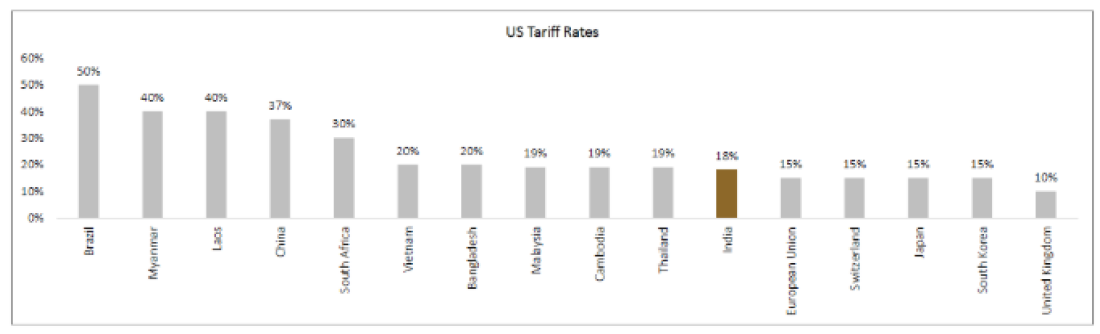
Source: MOFSL | Note: Tariff rates as on February 05, 2026
As highlighted, India’s tariff positioning sits meaningfully lower than several competing emerging market exporters. This relative positioning becomes important in the context of supply-chain realignment and trade competitiveness, particularly for labour-intensive and export-oriented sectors.
Market Performance Cycles: India vs Emerging Markets
Hiren also addressed concerns around recent underperformance of Indian equities relative to broader emerging markets (EM) by placing the data in a historical framework.
Rolling 365-Day MSCI India vs MSCI EM Performance
Periods where MSCI India has underperformed MSCI EM have historically been followed by phases of recovery and relative outperformance.
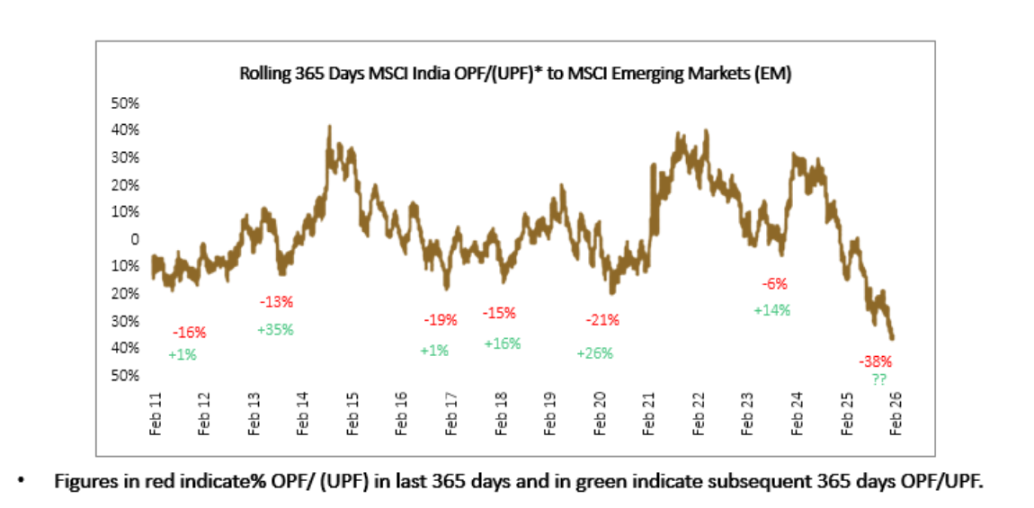
Source: Jefferies India Equity Strategy Report dated February 02, 2026
Note: *OPF - Outperformance, UPF – Underperformance
The point emphasised was not prediction, but perspective: relative underperformance phases are not unprecedented, and markets have historically gone through such cycles before normalising.
Union Budget FY2027: Capex Remains a Central Pillar
A significant portion of the discussion focused on the Union Budget FY2027, particularly government capital expenditure trends.
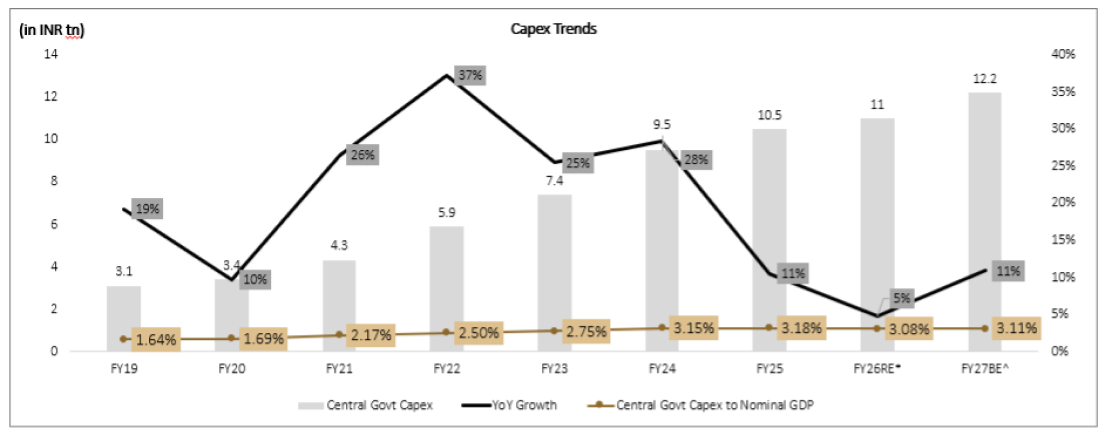
Source: India Budget Documents (https://www.indiabudget.gov.in/)
Note: *RE – Revised Estimates, ^BE – Budget Estimates
The commentary underscored the consistency of capex commitment, even as growth rates moderate from very high base levels. Importantly, capex as a percentage of GDP remains elevated, signalling continued focus on infrastructure-led growth.
Where Is the Capex Going? Quality and Composition
Beyond headline numbers, Hiren highlighted the composition of capex spend.
Capex Allocation (INR BN)
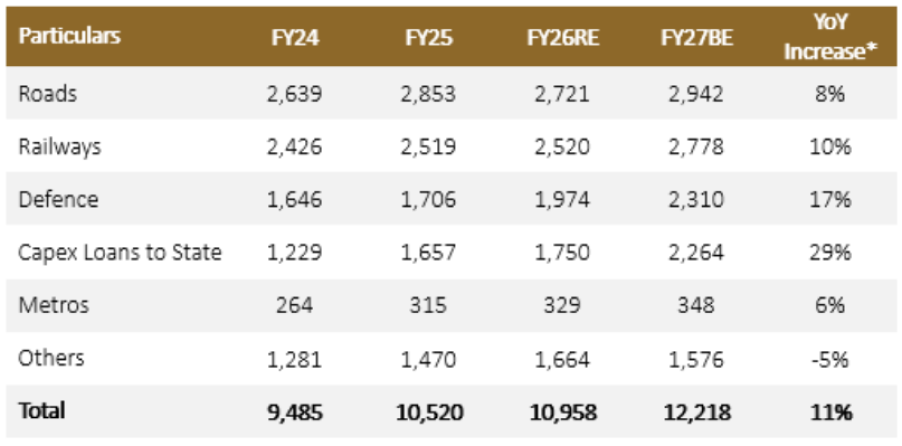
Source: India Budget Documents (https://www.indiabudget.gov.in/)
Note: *YoY Increase for FY27BE compared to FY26RE
Roads, railways, and metros continue to account for over half of total capex, while defence emerges as a notable growth area, supported by indigenisation and domestic sourcing initiatives.
Policy Reforms Supporting the Broader Economic Framework
Several structural policy measures were also discussed:
Income tax relief increasing disposable incomes
GST rate rationalisation towards a simpler two-rate structure
Labour code implementation improving workforce flexibility
FDI liberalisation, including insurance and space sectors
EU–India FTA progress, offering preferential access for exports
Gradual China Engagement
These measures, taken together, were positioned as supportive of medium-term growth rather than immediate market triggers.
F&O Markets and STT (Securities Transaction Tax):
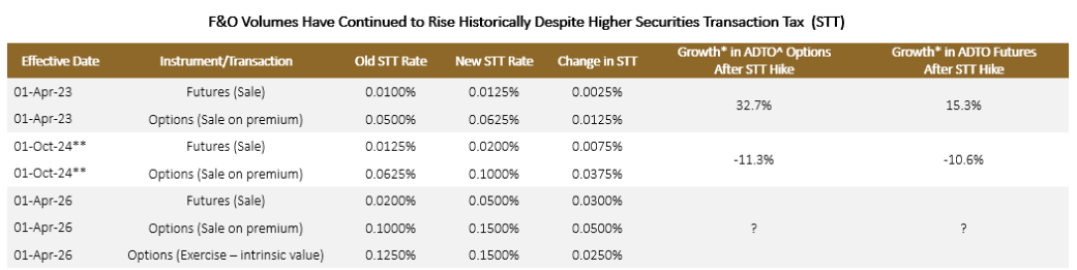
Hiren addressed concerns around higher STT and its impact on derivatives activity.
Source: NSE, BSE
Note: Growth is calculated for 12 months pre & post change in STT rates, ^Average daily turnover, *Change in STT during October 2024 had limited impact on Options & futures ADTO. October 2024 change was followed by a series of regulations by SEBI from December 2024 to March 2025, aimed at curbing retail participation which also played a role in decline.
The key takeaway was that STT hikes are not new, and previous increases have seen mixed short-term impact but did not structurally impair market participation over time.
Q3FY26 Earnings: Growth with Divergence
Earnings data formed another important anchor.
While margins moderated marginally, earnings growth remained positive across a broad base of companies.
Market Cap Segments: Large, Mid, Smallcaps
Largecaps showed steady revenue growth with stable margins
Midcaps delivered double-digit revenue growth but faced margin pressure
Smallcaps recorded healthy profit growth, albeit with higher volatility
This divergence was positioned as a reflection of differing base effects and cost dynamics rather than a uniform slowdown.
Putting It All Together: Data Over Noise
The February 2026 Market Views reinforced a recurring theme: markets move in cycles, but data provides context. Trade developments, fiscal policy continuity, and earnings resilience together paint a picture that is more nuanced.
Rather than reacting to individual data points, the emphasis remained on understanding trends, historical patterns, and structural drivers shaping India’s economic trajectory.
Closing Perspective
As highlighted above, India’s macro and policy framework continues to evolve with a long-term orientation, even as markets navigate phases of uncertainty. By grounding market views in data and historical context, investors are better positioned to interpret developments beyond short-term fluctuations.
Disclaimers:
This blog is for informational purposes only and should not be considered an offer or solicitation to buy or sell any securities or make any investments. We recommend readers take independent advice before making any investment decisions. Please refer to our Disclaimer and Disclosures for more details.