Understanding Market Capitalisation in Portfolio Construction

Market capitalisation is one of the parameters considered while constructing an equity portfolio. Large-cap companies generally offer scale and liquidity; mid-caps can balance growth with expanding business models, while small-caps may offer emerging opportunities with higher variability. Rather than viewing these categories in isolation, structured allocation across market caps can help build diversified equity portfolios aligned with clients’ long-term objectives, time horizons, and risk tolerances.
Why Market Capitalisation Matters in Portfolio Strategy
In equity investing, company size is more than a label. Market capitalisation influences liquidity, earnings visibility, institutional participation, volatility, and business maturity. As a result, the way a portfolio is allocated across large, mid, and small companies could materially shape its behaviour across market cycles.
Market cap allocation is not about identifying which segment is “better.” Instead, it is about understanding how each segment behaves and how they interact within a structured portfolio framework.
What Is Market Capitalisation?
Market capitalisation refers to the total market value of a company’s outstanding shares. It is calculated by multiplying the current share price by the total number of shares outstanding.
In India, the Securities and Exchange Board of India (SEBI) classifies companies into:
-
Large-cap: Top 100 companies by market capitalisation
-
Mid-cap: Companies ranked 101-250
-
Small-cap: Companies ranked 251 onwards
Market cap often reflects business maturity, operational scale, and market positioning. Larger companies tend to have diversified revenue streams and institutional ownership, while smaller companies may be earlier in their growth journey.
Large-Cap Companies: Scale, Stability, and Institutional Depth
Large-cap companies are typically established businesses with significant market share and diversified operations. They often attract strong institutional participation and analyst coverage.
From a portfolio perspective, large caps are commonly associated with:
-
Higher liquidity
-
Greater earnings visibility
-
Stronger balance sheets
-
Broader institutional ownership
During periods of heightened market volatility, large caps may exhibit relatively smaller price swings than smaller segments, though they remain subject to overall market cycles.
These characteristics may contribute to relatively lower volatility, and return profiles may vary across market capitalisation segments depending on growth cycles and market conditions.
Because of their scale, liquidity, and earnings visibility, large caps often form the core allocation in many structured equity portfolios.
Mid-Cap Companies: Expansion and Competitive Evolution
Mid-cap companies are businesses that have moved beyond early-stage operations but are not yet industry leaders in size. They may benefit from:
-
Growing industry demand
-
Operational efficiency improvements
-
Geographic or product expansion
However, mid-caps may also exhibit greater earnings variability than large caps. Their performance may be more sensitive to domestic economic conditions and sector-specific developments.
From a portfolio construction perspective, mid-caps can provide a balance between stability and growth acceleration, but allocations are often calibrated to account for liquidity and volatility.
Small-Cap Companies: Emerging Leaders and Higher Dispersion
Small-cap companies operate at earlier stages of scale than large and mid-cap counterparts. They may be niche leaders or emerging brands.
Characteristics often associated with small caps include:
-
Higher earnings dispersion
-
Greater sensitivity to economic cycles
-
Limited institutional ownership
-
Potential scalability
While small caps may represent emerging growth opportunities, their variability may underscore the importance of research depth, monitoring discipline, and position sizing within portfolios, in our view.
Small caps are typically associated with growth-oriented exposure, reflecting their potential for scalability, while also requiring careful evaluation due to higher variability in outcomes.
Comparing Market Caps Across Key Dimensions
To understand how different market-cap segments behave, it is useful to compare them by some of their structural characteristics.
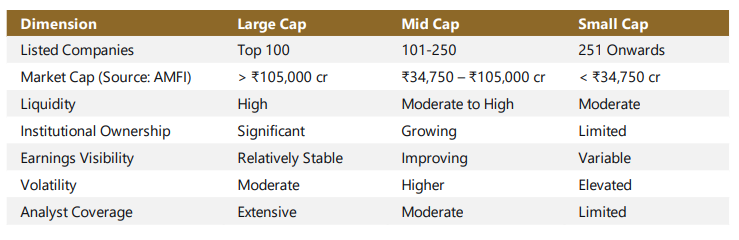
This broad comparison highlights that each segment carries distinct structural traits. Portfolio construction decisions often consider these attributes collectively rather than in isolation.
Market Cycles and Rotation Across Market Caps
Market leadership does not remain constant across cycles. Periods of economic expansion may see strong participation from mid and small caps, while phases of uncertainty may witness relatively stronger performance from large caps.
Liquidity conditions, earnings cycles, and investor sentiment can influence rotation across segments. However, consistently predicting such rotations may be difficult. Because of this, structured allocation frameworks often focus on balance rather than short-term timing across segments.
Multi-Cap and Market-Cap Agnostic Approaches
Beyond single-segment exposure, some portfolio strategies allocate across market caps without rigid size constraints.
In a multi-cap approach, exposure may be diversified across large, mid, and small companies as part of the strategy design.
In market-cap-agnostic frameworks, allocation decisions are driven primarily by bottom-up stock selection rather than by predefined size buckets. Such strategies can adjust exposure based on opportunity, valuation, or conviction levels.
These flexible approaches aim to:
-
Avoid structural bias toward any single cap segment
-
Capture opportunities wherever they emerge
-
Balance diversification
Importantly, flexibility in allocation does not eliminate risk but may broaden participation across market segments within defined portfolio parameters.
Conclusion: Balancing Scale, Growth, and Flexibility Across Market Caps
Market capitalisation is a structural lens through which equity portfolios can be evaluated and constructed. In general, large caps offer scale and liquidity; mid-caps may provide growth; small and micro caps introduce emerging opportunities alongside higher variability; and flexible allocation strategies may allow participation across segments.
No single market cap segment consistently leads across all phases. Structured allocation across size categories, aligned with long-term investment objectives, can help balance scale, growth, and opportunity within equity portfolios.
At Alchemy, our Portfolio Management Services (PMS) offerings span a range of strategies across market capitalisations. Understanding these approaches may help investors evaluate how market-cap exposure fits within a broader portfolio context.
Write to us at contactus@alchemycapital.com to know more.
Disclaimers:
This blog is for informational purposes only and should not be considered an offer or solicitation to buy or sell any securities or make any investments. We recommend readers take independent advice before making any investment decisions. Please refer to our Disclaimer and Disclosures for more details.
General Risk Factors:
-
All products / investment approach attract various kinds of risks. Please read the relevant Disclosure Document/ Client Agreement/ Offer Documents (includes Private Placement Memorandum and Contribution Agreement) carefully before investing.
General Disclaimers:
-
The information and opinions contained in this report/ presentation have been obtained from sources believed to be reliable, but no representation or warranty, express or implied, is made that such information is accurate or complete.
-
Information and opinions contained in the report/ presentation are disseminated for the information of authorized recipients only and are not to be relied upon as advisory or authoritative or taken in substitution for the exercise of due diligence and judgement by any recipient.
-
The information and opinions are not, and should not be construed as, an offer or solicitation to buy or sell any securities or make any investments.
-
Nothing contained herein, including past performance, shall constitute any representation or warranty as to future performance.
-
The client is solely responsible for consulting his/her/its own independent advisors as to the legal, tax, accounting and related matters concerning investments and nothing in this document or in any communication shall constitutes such advice.
-
The client is expected to understand the risk factors associated with investment & act on the information solely on his/her/its own risk. As a condition for providing this information, the client agrees that Alchemy Capital Management Pvt. Ltd., its Group or affiliates makes no representation and shall have no liability in any way arising to them or any other entity for any loss or damage, direct or indirect, arising from the use of this information.
-
This document and its contents are proprietary information of Alchemy Capital Management Pvt. Ltd and may not be reproduced or otherwise disseminated in whole or in part without the written consent.
-
The information and opinions contained in this document may contain “forward-looking statements”, which can be identified by the use of forward-looking terminology such as “may”, “will”, “seek”, “should”, “expect”, “anticipate”, “project”, “estimate”, “intend”, “continue” or “believe” or the negatives thereof or other variations thereon or comparable terminology. Due to various risks and uncertainties, including those set forth under the Disclosure Document/Offer Documents, actual events or results or the actual performance may differ materially from those reflected or contemplated in such forward-looking statements.
Regulatory Disclosures:
-
All clients have an option to invest in the above products / investment approach directly, without intermediation of persons engaged in distribution services.
-
This document, its contents, especially the Performance related information, is not verified by SEBI or any regulator.